
About the FWWCP
The Federation of Worker Writers and Community Publishers (FWWCP) was a network linking the many community-based writing and publishing groups that flourished in the UK during the last decades of the twentieth century. Such groups were voluntary and community-run, meeting to facilitate working-class people in producing, sharing and discussing their creative writing and community self-publication. Between 1976 and 2007, the FWWCP supported the work of over 120 writing and publishing groups, with some also joining from other countries.
The organisation thrived in the context of significant political and economic change and a broader counter-cultural movement. The fundamental ideas underpinning the FWWCP were that everyone could participate in cultural production and that this could be a collective endeavour. Through poetry, prose, fiction, biography, autobiography and local history, FWWCP publications documented the changing lived experience of working-class people over a thirty-year period. Publications explored how class intersected with gender, sexuality, race/ethnicity, disability, mental health, culture and literacy, giving expression to an emergent identity politics at this time. FWWCP members often organised events to share writing and celebrate creativity through performance.
The TUC library at London Metropolitan University holds an archive of thousands of publications from FWWCP member writing groups, as well as the organisation’s records and bi-annual magazines, making it the most significant collection from this network in the UK: https://collections.londonmet.ac.uk/records/TUC/FWWCP

The original logo of FWWCP

Covers of the Fed News magazine
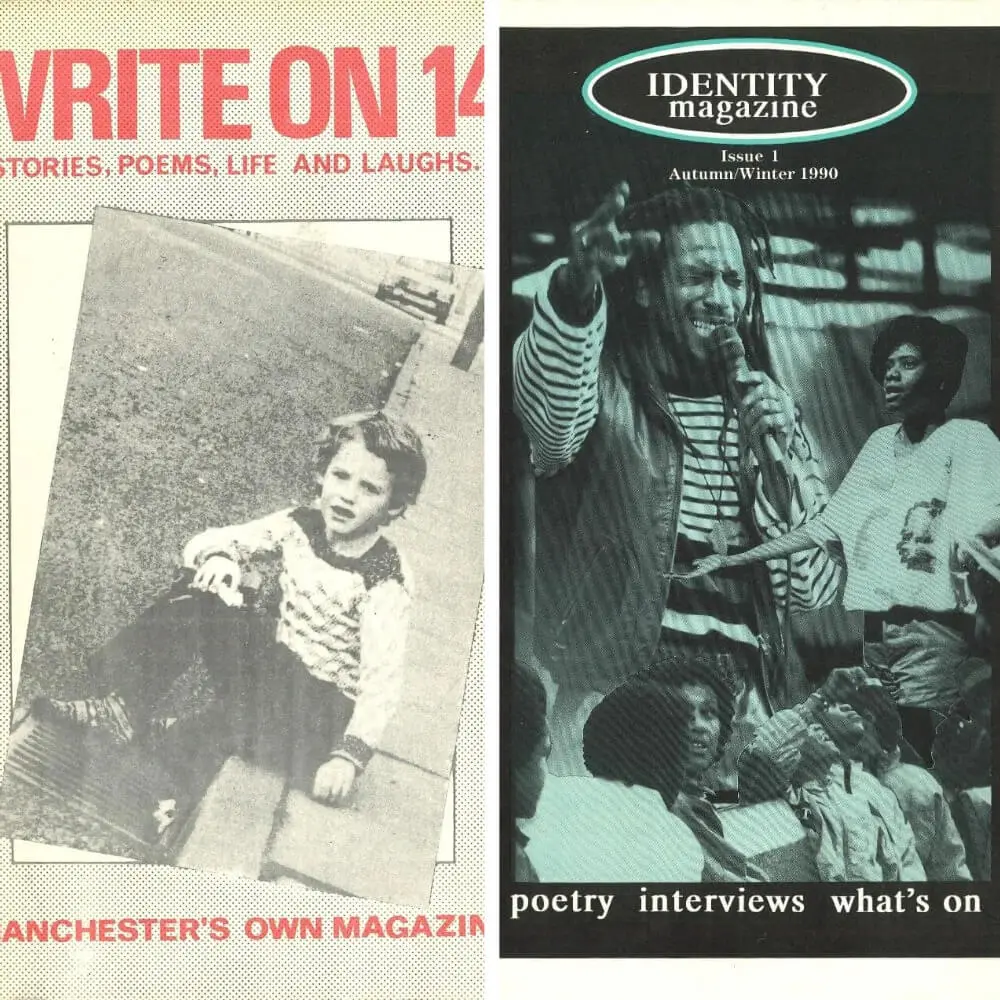
Magazine covers
Key Events
1960s-1970s
a growing counter cultural movement, with the emergence of local alternative press newspapers such as QueenSpark (1972) in cities across the UK and writers’ workshops, pedagogical changes in schools relating to the teaching of English, developing radicalism in schools among students and educators
1971
- Stepney Words published, teacher Chris Searle sacked and school students strike
- Centerprise opened in Dalston, Hackney (London)
1973
‘Right to Read’ campaign and a widening concern about the extent of illiteracy amongst adults; Scotland Road writers workshops forms in Liverpool from people involved in earlier rent strikes in Merseyside; Basement Writers workshop formed with pupils from Stepney
1976
Federation of Worker Writers and Community Publishers (FWWCP) formed by 8 groups. Groups rather than individuals can be members.
1978
Writing the first anthology of the FWWCP’s writing produced and distributed
1970s – mid 1980s
Significant change in print accessibility: electronic typewriters with plastic daisywheels, and direct to plate off set litho printing as well as improvements in photocopying made print processes much more accessible than letter press. Groups could access community workshops and produce their own publications.
1980
- Voices adopted by the FWWCP as its magazine
- Vivian Usherwood’s Poems published, eventually selling 10,000 copies
1981
Captain Blackbeard’s Beef Creole and other Caribbean Recipes published, Peckham PP
1982
The Republic of Letters, a representative compendium of FWWCP groups’ writing, published by David Morley, Ken Worpole and others
1982/3
Roger Mills funded as the FWWCP’s worker by the Arts Council for a short time. Regional arts bodies continued to fund individual FWWCP groups
1983/4
Inner London Education Authority begins publishing booklists including FWWCP writing (mostly from London workshops) for use in community writing in schools
1984/5
FWWCP begins publishing booklists featuring women’s writing and black writing
1985
‘Once I was a Washing Machine’, FWWCP poetry anthology published
January 15, 2024
1986(?)
- Al Thomson became the FWWCP’s first worker, followed by Tracy Ryan in 1988, and Tim Diggles in 1989/90. The FWWCP’s membership is expanded and diversified
- ‘Voices’ ceased publication and ‘FWWCP Newsletter’ issued 4 times a year in its place
1988/9
Tracy Ryan starts to collect the nucleus of the FWWCP archive. Although there were already private collections, the Fed started to assemble its own record.
1989
Fed News, revived newsletter published 4 times a year, edited by Janice Day
1990
Nick Pollard becomes editor of Fed News
1990s
Development of Microsoft and Adobe pagemaker software enables the layout and production of cheaper but better finished publications on home computers
1991
- Fed News relaunched as Federation Magazine edited by Nick Pollard and Pat Smart 4 times a year distributed to all member groups. Production ceased in 2007.
- Survivors Poetry, a network of psychiatric survivors, joins the FWWCP leading to significant collaborations with survivor poets and their organisations.
1993 and 1996
Visits to Travail et Culture (TEC/CRIAC) conference and workshops in Lille/Roubaix and Calais, France. Recognition of international interest in UK working class culture and the FWWCP model of community organisation
1994/5
Reds Under the Beds tour of the US and Canada with Tom Woodin, Roger Drury and others, performance tour of some Working Class Studies and Museum locations
1996
Publication of ‘Writing on the Line’, edited by Sarah Richardson, a collection of biographical details of working-class women writers and essays, published by Working Press.
1997(?)
FWWCP invited to join committee for the Raymond Williams Prize, which awarded £3,000 for community publications
2001
Labour Party launches ‘skills for life’ campaign, involving a shift away from long term to vocational education. Radical adult literacy projects find it difficult to continue
2002
FWWCP starts project to take community writing to marginalised groups. ‘Voices talk hands write’ developed in Grimsby, with Pecket Learning Community and Grimsby Writers.
2006
FWWCP visit to Syracuse University, New York
2007
FWWCP dissolves, Federation materials stored at Pecket Learning Community
2008
The Fed: A network of writers formed from FWWCP members groups. Partnership with Syracuse University through Steve Parks and Jess Pauszek enables continued annual meetings and setting up of an archive project
2009
Republication of Republic of Letters as an expanded edition
2016
FWWCP archive transferred from Pecket to TUC Library on suggestion of Cilla Ross
January 15, 2024
2018
Tom Woodin’s History of Working Class Writing and Community Publishing, published by MUP
2025
Jess Pauszek’s Worker Writers, published by CCCC
2025/6
FWWCP oral history project led by Jenny Harding, with Nick Pollard and TUC library